 FIXSIM
FIX Connectivity Testing for OMS/EMS Vendors
OMS and EMS vendors live or die on connectivity. This is the five-stage pre-production discipline that catches FIX integration failure modes before they touch a real broker, exchange, or buy-side firm.
- Session-layer + application-layer testing
- Negative-path coverage (rejects, gaps, disconnects)
- Stress, load, and certification rehearsal
The five stages of pre-production FIX testing
- Session-layer validation - logon, heartbeat, resend, sequence recovery.
- Functional flow - order lifecycle, executions, cancels, modifies.
- Negative testing - rejects, malformed messages, sequence gaps, disconnects.
- Performance, load, and endurance - sustained throughput, latency under stress, multi-day stability runs.
- Certification rehearsal - dry-run the venue’s cert script in a controlled environment before the real certification.
Why this matters
A FIX integration that fails in production:
- Triggers customer-facing outages with regulatory and reputational cost.
- Burns weeks of engineering on post-mortem and re-certification.
- Often blocks the next customer onboarding while everyone investigates.
Stage 1: Session-layer validation
The FIX session layer is where most regressions hide. Your tests must cover:
- Logon handshake - sender/target CompID matching, heartbeat interval negotiation, ResetSeqNumFlag handling.
- Heartbeats - bidirectional, on schedule, with TestRequest fallback.
- Resend logic - both initiating and responding to ResendRequest, with proper gap-fill (PossDupFlag + SequenceReset).
- Sequence recovery - restart with persisted sequence numbers, recover after both sides crash.
- Disconnect / reconnect - graceful logout, ungraceful TCP drop, mid-message disconnect.
With FIXSIM: spin up a counterparty session, deliberately break each behavior in turn (skip heartbeats, send wrong CompID, force a sequence gap), assert your OMS responds correctly.
Stage 2: Functional flow
For every order type, asset class, and venue you support:
- NewOrderSingle → ExecutionReport (New, PartialFill, Fill, Canceled, Rejected, Expired)
- OrderCancelRequest → OrderCancelReject or cancel ExecutionReport
- OrderCancelReplaceRequest → updated ExecutionReport (or reject)
- OrderMassStatusRequest → cascade of status reports
- TradeCaptureReport workflows for post-trade
- Drop copy sessions and reconciliation
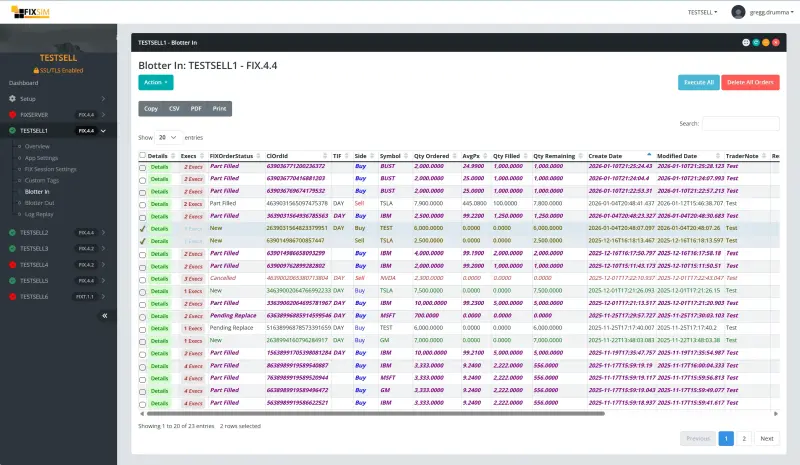
With FIXSIM: the Rule Builder lets you encode venue behavior ("market orders always fill at $X", "limit orders reject if outside the band") and reuse the same rules across your regression suite.
Stage 3: Negative testing
The real risk is in the unhappy path: that’s where most production incidents originate and where most debugging time is spent later. Allocate serious test surface to:
- Malformed messages - missing required tags, invalid enum values, bad BodyLength/CheckSum, out-of-order tags.
- Sequence anomalies - gaps, duplicates, out-of-order, sequence reset abuse.
- Reject paths - business reject, session-level reject, custom venue rejects.
- Slow counterparty - what does your OMS do when the venue takes 30 seconds to respond? 5 minutes?
- Network failures - TCP RST mid-message, slow consumer, half-open sockets.
- Capacity edge cases - order quantity at the FIX max, prices with extreme precision, symbols at length limits.
With FIXSIM: every negative scenario is a Rule Builder template: store it, version it, run it in every regression cycle.
Stage 4: Performance, load, and endurance
For vendors targeting institutional clients:
- Throughput - sustain N orders/sec for M minutes; assert no message loss, no sequence gap, p99 latency under threshold.
- Burst - 10× peak load for 10 seconds; assert graceful recovery.
- Endurance - 24-hour run at realistic load; assert no memory leak, no log fragmentation, no socket exhaustion.
- Concurrent sessions - N sessions simultaneously, often with different FIX versions.
With FIXSIM: the REST API drives high-volume scenarios programmatically; performance results integrate into your CI dashboard.
Stage 5: Certification rehearsal
Before the venue's real certification session:
- Mirror the venue's published certification script in your test environment.
- Run it end-to-end with zero engineer intervention: every message scripted.
- Capture the full session log for review.
- Identify failure points and iterate until every scenario passes.
- Only then book the real cert slot.
Teams that rehearse certification this way generally finish the live cert in fewer cycles; most surprises have already been found and fixed before the venue is in the loop.
With FIXSIM: import the venue's cert script as a sequence of Rule Builder scenarios; replay until green.
Spin up a FIX counterparty in 5 minutes and start running these stages today.
How FIXSIM supports OMS/EMS vendors across all five stages
FIXSIM is built on the open-source QuickFIX engine library, with a SaaS UI, REST API, multi-user accounts, Rule Builder, and log replay layered on top. For OMS/EMS pre-production testing this combination maps onto each stage:
| Pre-prod testing need | How FIXSIM covers it |
|---|---|
| Session-layer validation (logon, heartbeat, resend, sequence) | QuickFIX engine + Rule Builder triggers |
| Functional order-flow validation | REST API + browser blotter |
| Negative-path scripting (rejects, gaps, malformed messages) | Rule Builder scenarios, replayable per release |
| Performance, load, and endurance testing | REST API drives high-volume scenarios |
| Certification rehearsal before live cert | Import the cert script as Rule Builder scenarios; replay until green |
| On-premises deployment for compliance / audit | FIXSIM on-prem deployment, on request |
| Custom QuickFIX data dictionaries | Drop in directly: same QuickFIX format |
What typically goes wrong (post-mortem patterns)
From OMS/EMS launches we've seen:
- Sequence-number persistence - works in dev (in-memory), fails in prod (database lag).
- Heartbeat under load - heartbeats delayed past the timeout when the message thread is busy.
- Custom tag handling - venue adds a new tag, OMS silently drops it, fills look fine but allocation breaks.
- Reject-on-reject loops - venue rejects a message, OMS rejects the reject, venue disconnects.
- Time-in-force defaults - OMS assumes DAY when venue assumes IOC, every order expires unfilled.
